Case study — Design Systems
Logan Hollowell Jewelry Design System
Tokens, components, Storybook, and validation behind the Logan Hollowell storefront, from Figma to production.
In one breath. After two years of building the storefront one page at a time, we had dozens of buttons, headings, and layouts that almost matched. I audited what we had, defined 254 tokens across three tiers, and built a component library that connects Figma to the Shopify theme. We shipped 109 custom sections on it in seven weeks, then added Storybook and automated checks to keep design and production from drifting apart.
254
Tokens across three tiers
92%
Of Figma component instances from the library
109
Sections shipped in 7 weeks
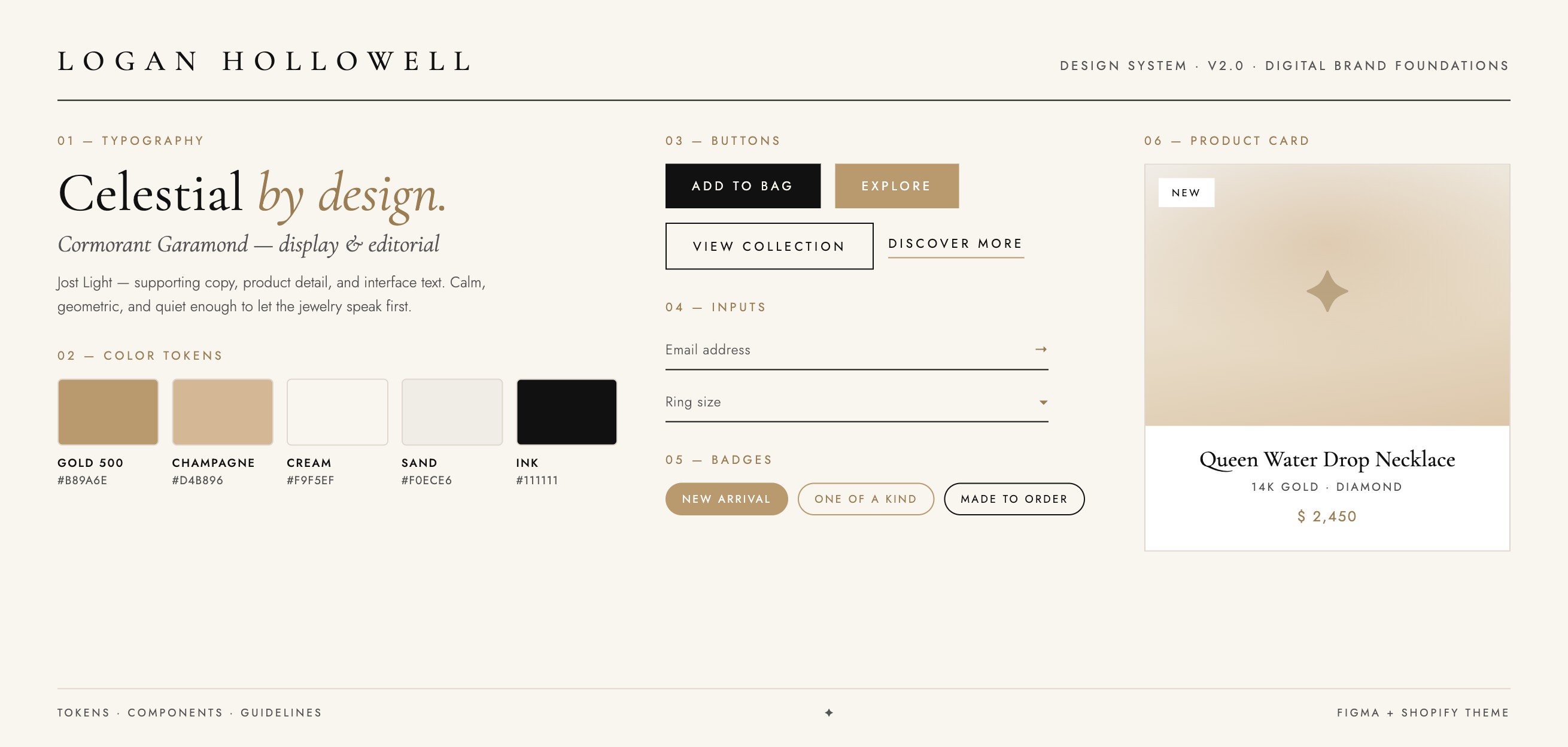
The Problem
We had built a lot of product without building the system underneath it.
Every campaign, seasonal drop, and new feature had added a section that was almost right. Underneath sat Shopify's base theme with its own CSS, type, and spacing, plus years of additions on top. Buttons didn't quite match. Product cards behaved differently depending on where they showed up. For a luxury brand, "almost" is the difference between premium and ordinary.
The same foundation also had to support the mobile app. We needed something a small team could move fast with, without turning the brand into a generic kit.
The reframe
How might a small team ship every new page, on web and in the app, so that it looks as considered as the first one?
Enough structure to move faster, with room left for the brand to stay expressive.
The Audit
Before building anything new, I audited every component, color, and type style across the storefront, emails, and campaign pages. It turned up dozens of near-duplicates.
For each one I asked: is this variation intentional, or is it drift? Some differences solved real problems. Most were different answers to the same problem. That question decided what went into the system and what stayed flexible.
Tokens
Tokens gave the system a shared language.
254 tokens in three tiers. Core tokens (165) hold raw values: color, type, spacing, radii, shadows. Semantic tokens (19) describe the job, so we design with "primary text" or "subtle background" instead of a specific grey. Component tokens (70) hold decisions for a single component, like a button's padding.
52 tokens point to other tokens rather than holding a value, so a semantic change doesn't mean redesigning every component that uses it. In the theme, 117 CSS variables carry those decisions into production.
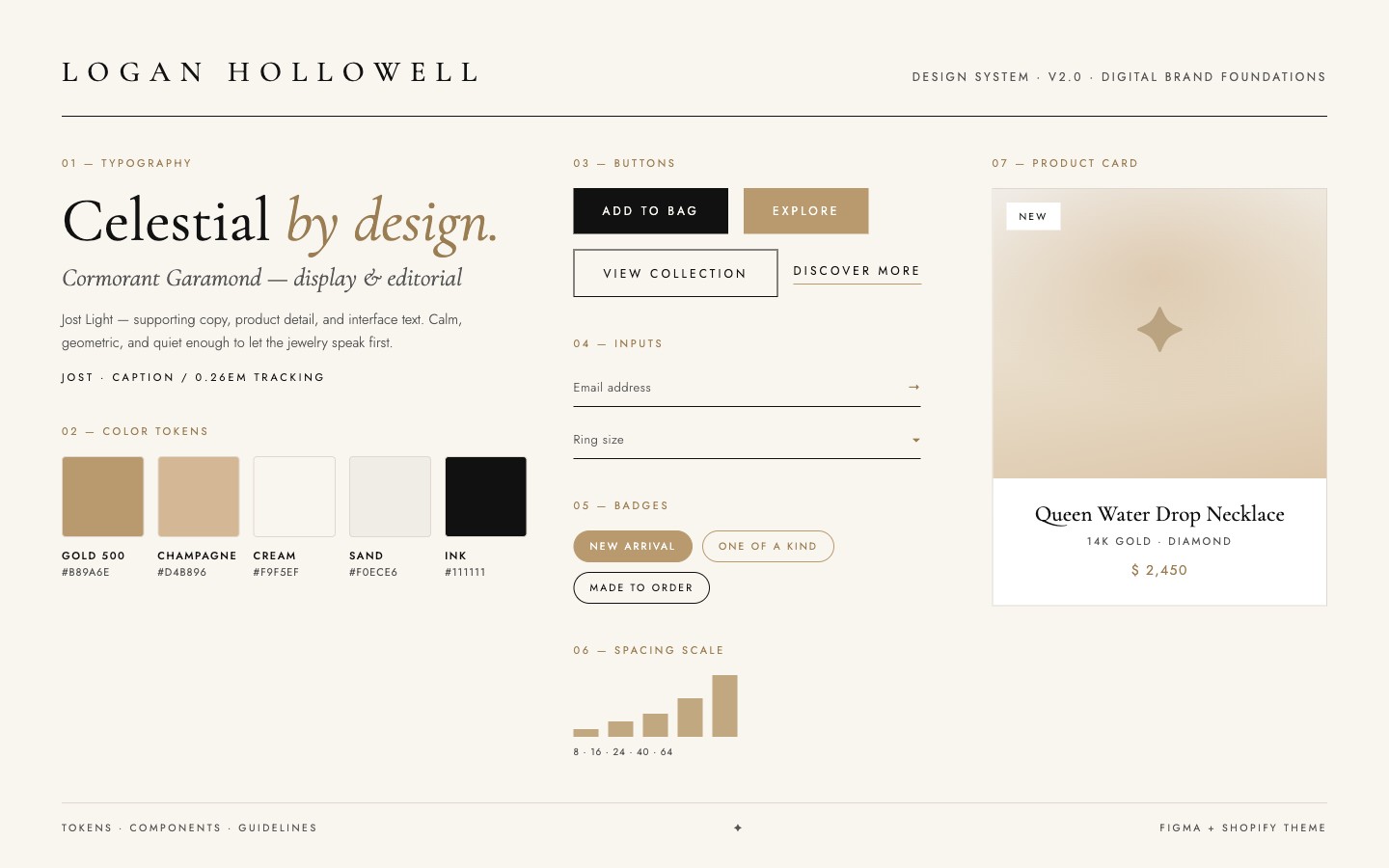
Raw values on the left, jobs on the right. Primary, secondary, and muted text point to different neutrals, so the difference between them is a decision made once instead of guessed on every page.
Components and States
A component isn't finished when the default state looks right.
Many Logan Hollowell pieces are one of a kind, so the product card needed a sold-out state from day one. It swaps the price for a status and adds a waitlist button. Before that, every page handled sold out its own way.
Every component in the Figma library ships with its states (navigation, product cards, editorial blocks, forms, checkout), so whoever builds a page picks a state instead of inventing one.
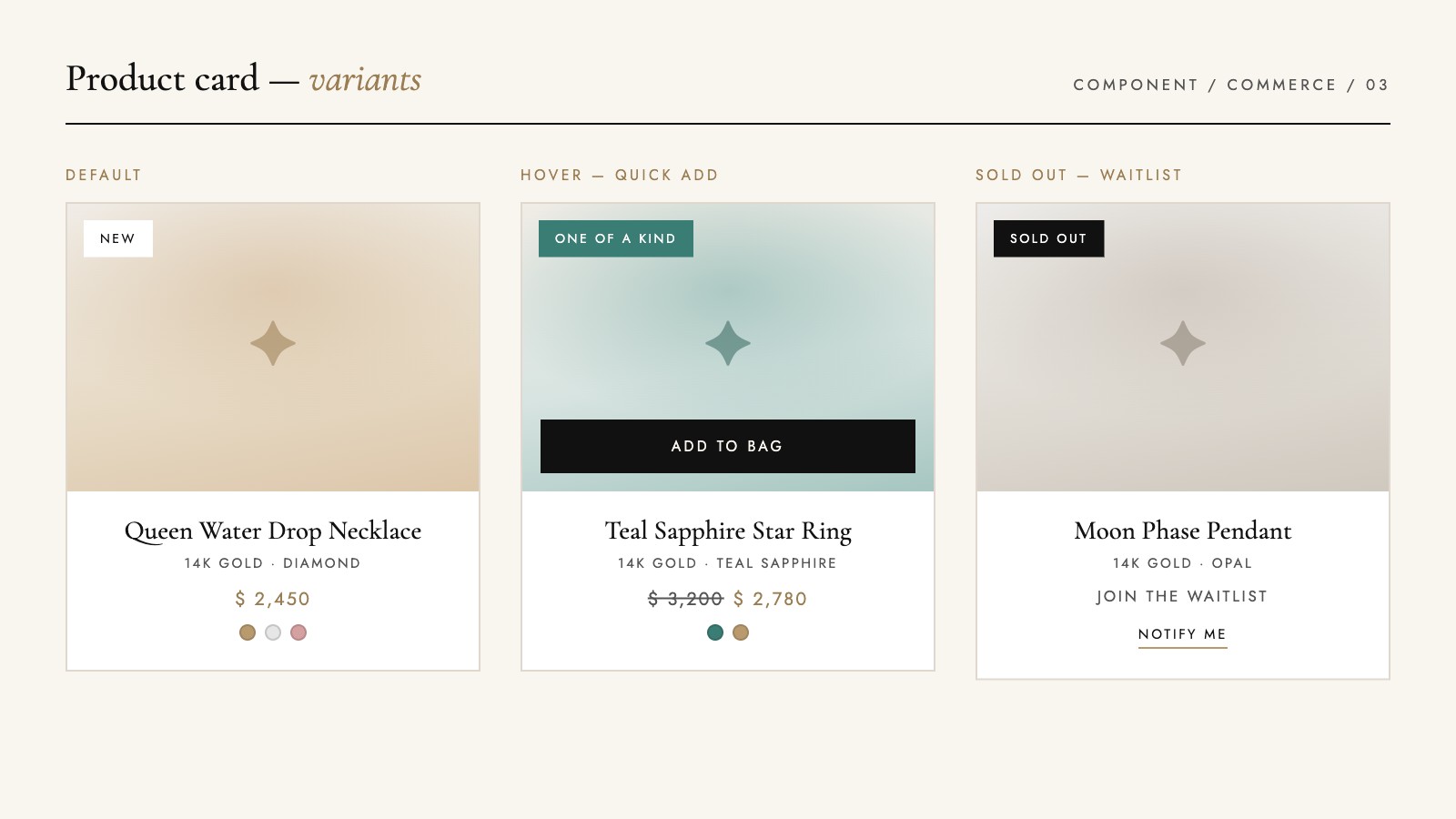
Sold out isn't a dead end. Many pieces are one of a kind, so the product card needed a sold-out state from day one. It swaps the price for its status and adds a waitlist button. A business constraint became part of the component instead of something solved differently every time it appeared.
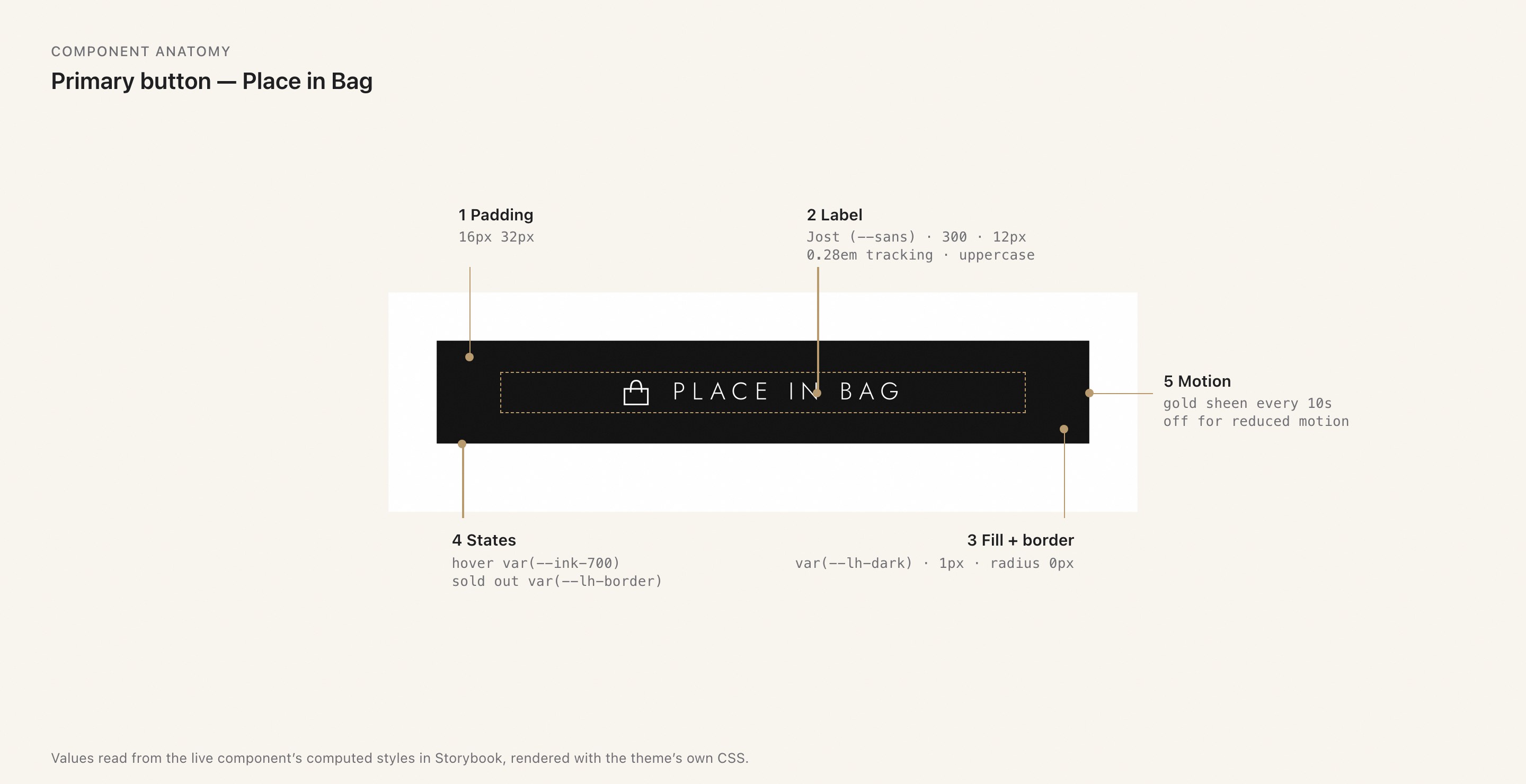
Every value here was read from the live button, not typed. Fill, border, typeface, and hover state all come from the system's tokens, so the anatomy and the production button answer to the same decisions. The component shouldn't depend on someone remembering how it works. The system should already know.
Accessibility
Fixing accessibility in a component fixes it everywhere that component is used, so that's where we did it.
Vasken led reviews on pieces like the contact drawer, and together we brought small text and prices up to WCAG AA. Tokens note where a color only passes on certain backgrounds.
There's one focus ring, owned by the shared stylesheet, and it changes color to stay visible over the dark homepage hero. Drawers return focus to the button that opened them. The button's gold sheen turns off for anyone who has asked their device to reduce motion.
One Library, Two Places
I didn't want a polished Figma library sitting next to a different production reality.
There's no separate code library to keep in sync. Components are built directly into the Shopify theme as sections and snippets, each with a matching component in Figma.
The storefront rebuild tested this. One product template now covers pieces from $2,675 to $55,650. A high-value piece adds storytelling, like a note from the founder, instead of getting its own template that slowly drifts from the first. That became a rule for the system: standardize the foundation, not every expression of it. (Storefront case study →)
A Storybook That Can't Drift
Documentation is only useful if people can trust it.
Shopify's templating language only runs on Shopify's servers, so a normal Storybook would have meant maintaining a second copy of every component. Instead, each story uses the HTML its template renders, styled by the theme's own stylesheet. Storybook shows what customers actually see.
Each component page has a Design tab with the matching Figma frame, and any difference between Figma and production is written down. The primary button matches except for its hover color, for example. The question shifts from "does this match Figma?" to "where does it differ, and should it?"
It covers five components and three foundation pages so far, and it's still growing.
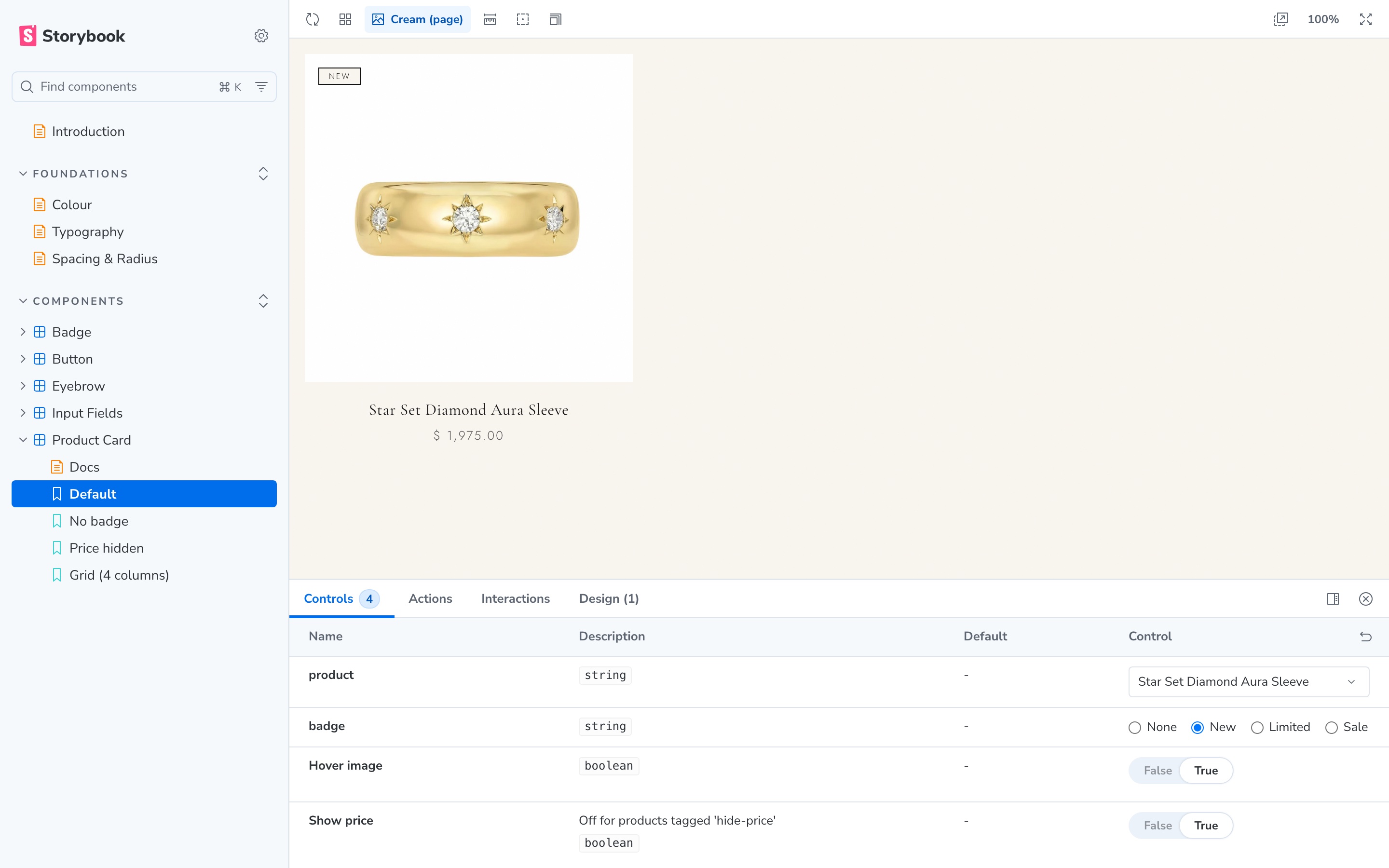
The product card, rendered by the theme's own CSS. Controls switch between real states, including badges, hover images, and hidden prices for products tagged to hide them, so a state can be checked before a page depends on it.
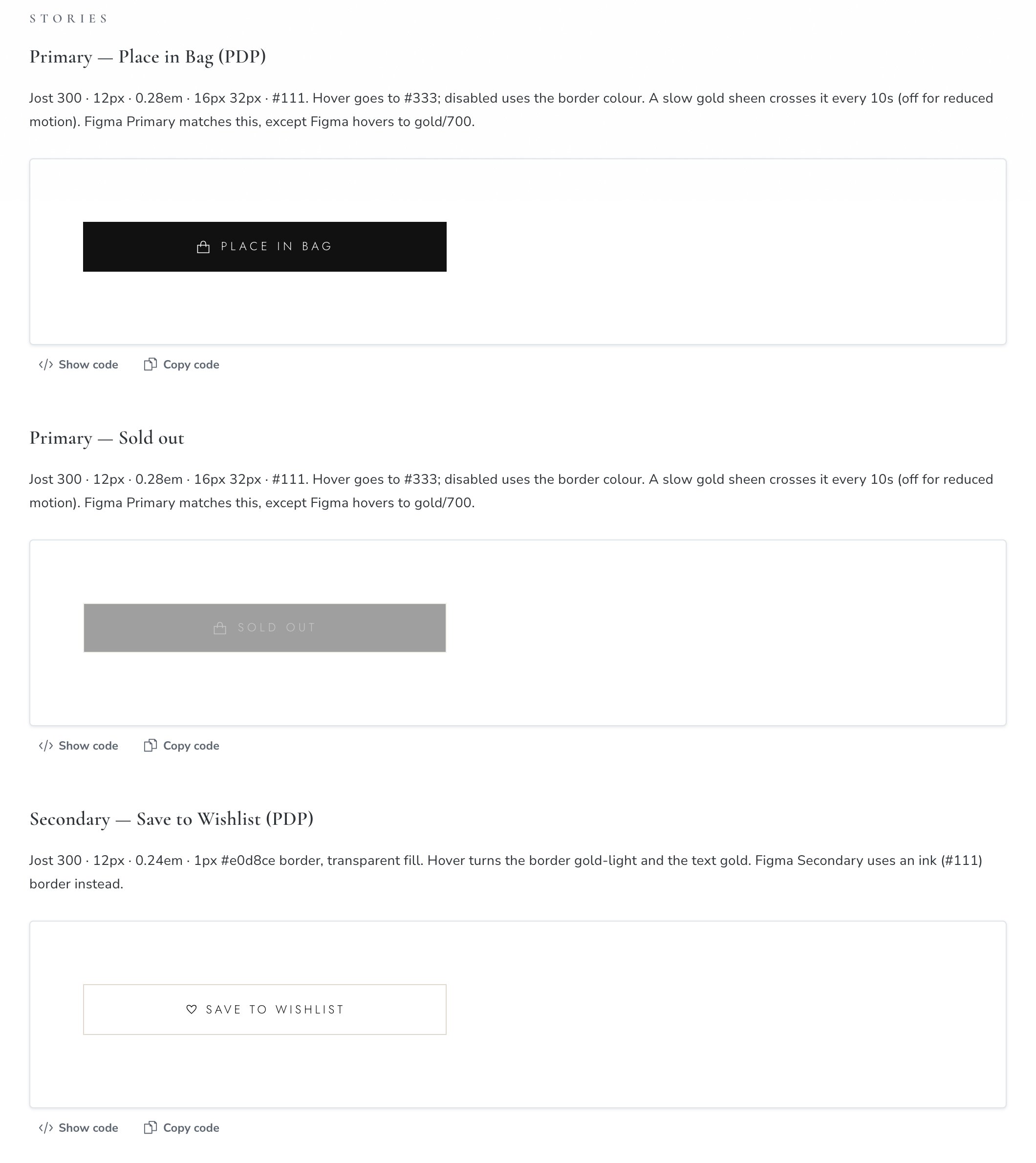
Each story says where Figma and the site disagree. The primary button matches Figma except for its hover color; the secondary button's border differs. Writing the gaps down turns drift into something we can resolve.
Shipping It
The system had to hold up at real production speed.
Between March 11 and April 30, 2026, we shipped 109 custom sections and snippets on the new foundation, and 134 by September.
By September the theme had five stylesheets. I merged them into one, removing 3,218 duplicate rules (18,375 lines). To do that safely on a live store, I first built a comparison tool that captures every page at three screen sizes, records the computed style of every element, and diffs before and after. It now covers 33 pages, 99 screens per change. Once checking was cheap, cleaning up was safe.
109
Sections in 7 weeks
Custom sections and snippets added 11 Mar – 30 Apr 2026, from the theme's Git history.
5 → 1
Stylesheets
Merged in September 2026, removing 3,218 duplicate rules.
99
Screens checked per change
33 pages × 3 screen sizes, compared screenshot by screenshot and style by style.
Building with AI
AI made the design system more important, not less.
Since March 2026, 903 of my 965 commits to the theme were made with Claude Code, including the Storybook, the comparison tool, and the stylesheet cleanup.
A designer on a product for years absorbs the brand and its exceptions. An AI tool only knows what you give it, and the design system is most of what I give it: tokens as constraints, components as patterns, Storybook as the reference for what correct looks like.
It still isn't enough on its own. Some generated code still lands off the palette, which is why the system needs checks, not just documentation.
Measuring Adoption
A design system existing doesn't mean the product is using it.
Vasken and I were the whole design team, so the Figma number isn't an org-wide adoption story. It answers a simpler question: were we actually designing with what we built? Across our active files, 92% of component instances come from the shared library.
Production was a different story. I measured all 4,486 color values in the custom theme files. 62% matched the palette, but only 24% went through a variable that would follow a palette change. The rest were hard-coded copies, many inherited from the base theme.
Closing the gap
During the rebuild, speed won. In September I added the missing grey and footer tokens, then moved every hard-coded color that matched a token onto it: 1,278 replacements, verified with the comparison tool, no visual change. Colors on variables went from 24% to 43%. Tints and colors that still need a token are the next phase.
How It Grows
Changes happen in the open, and patterns earn their place.
Every new component or change goes to a shared review board in Slack, where Marketing, Production, Operations, and Management can weigh in before it ships. People who depend on the system hear about changes before customers do.
A pattern doesn't enter the system the first time we build it. Once we've built it three or four times, I review it and promote it. Building it a few times first shows what actually repeats.
What I'd Do Differently
I'd enforce typography earlier.
The type scale exists in the tokens, but fewer than one in ten font sizes in the custom code use it. Color problems were easy to see. Typography drifted quietly.
If I started again, I'd ship the type tokens with an automated check that flags any off-scale size before the first section ships, not after the hundredth.
Where It Stands
This isn't a finished system, and I don't think it should be.
It's a foundation the storefront was rebuilt on, with the measurements to show where it holds up and where it doesn't yet.
92%
Library use in Figma
Component instances in our active design files that come from the shared library.
109
Sections in 7 weeks
Built on the system during the storefront rebuild, Mar–Apr 2026.
24% → 43%
Colors on tokens
Color values in the theme code that follow a palette change, Sept 2026.
- Figma defines intent.
- Tokens give decisions names.
- Components make those decisions reusable.
- Production tests whether they hold up.
- Storybook makes the current state visible.
- Measurement shows where the system needs to improve.
Next case study
Bedell Property Management →Hiring for a Product Design or Design Systems role?
Get in touch